
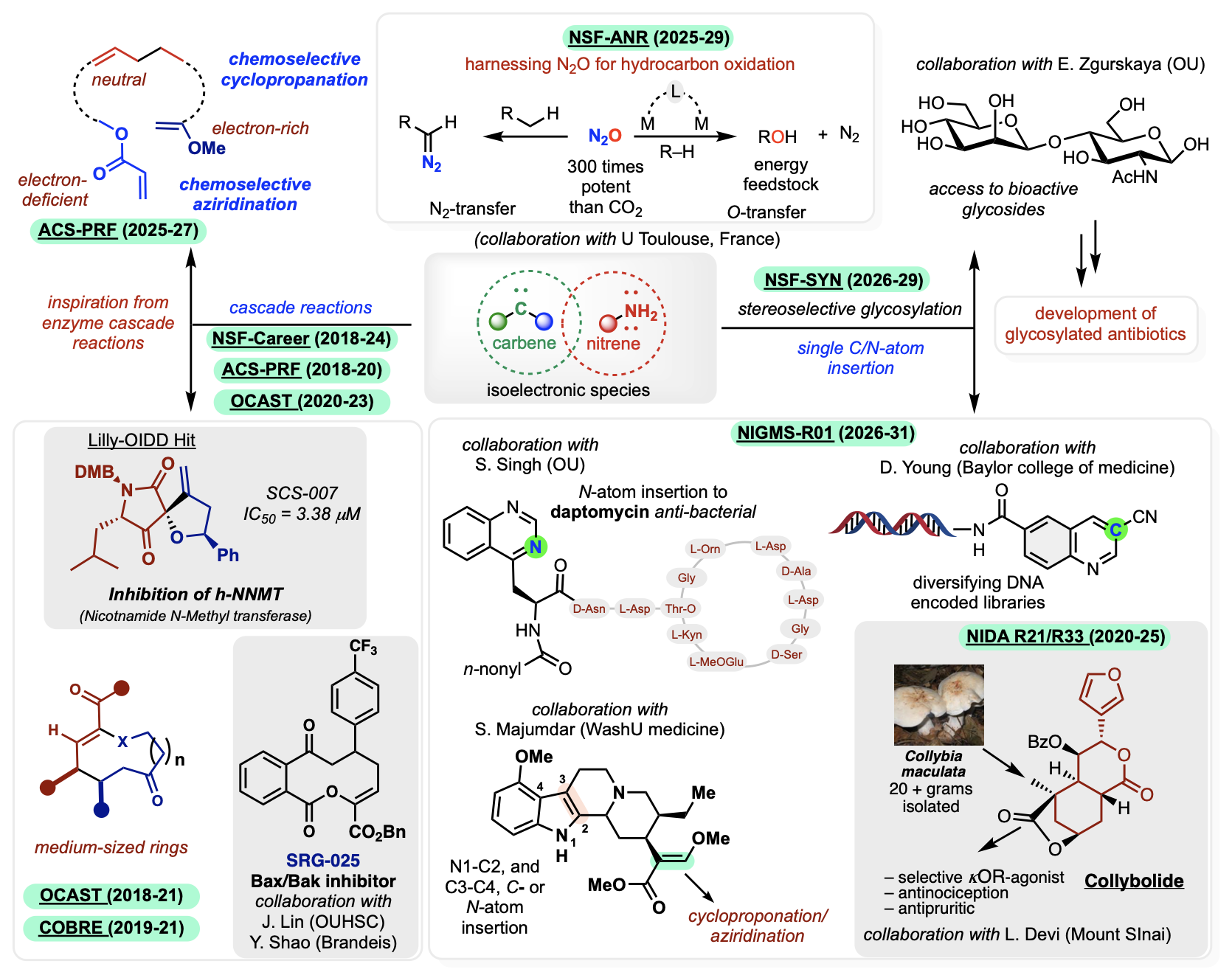
Drug discovery has stagnated in recent decades, with the cost of a single approved drug exceeding $4 billion, a crisis rooted in the limited structural diversity of screening libraries. As Nobel laureate Sir James Black observed, “The most fruitful basis for the discovery of a new drug is to start with an old drug.” Our research program operationalizes this insight: the CNS group develops strategies to directly remodel existing molecular scaffolds via site-selective, late-stage transformations, enabling scaffold hopping of privileged N-heterocycles and other bioactive scaffolds, thereby expanding the accessible chemical space without stepwise de novo synthesis. At the core of this vision is the Carbene/Nitrene Synthesis (CNS) platform, built on six-electron, isoelectronic reactive intermediates that unlock reactivity beyond traditional two-electron chemistry (Want to know more about Carbenes and Nitrenes? Click here). A defining feature of our approach is sulfur's metallomimetic role, which stabilizes carbenes and nitrenes and enables precise chemoselective transformations that eliminate reliance on precious-metal catalysts (Rh, Au) and their associated environmental burdens and pharmaceutical contamination limits (≤10 ppm). Sulfur, the 5th most abundant element in Earth’s crust, present in ~23% of FDA-approved drugs, and central to site-selective transformations, is an ideal sustainable partner for this chemistry.
The platform integrates three synergistic pillars: (i) sustainable generation of reactive intermediates via photochemical activation and earth-abundant metal catalysis (Fe, Cu, Zn); (ii) late-stage skeletal editing for modification of complex bioactive scaffolds; and (iii) translation to drug discovery through DEL synthesis, stereocontrolled glycosylation, and antibiotic innovation. This framework enables a seamless progression from reaction discovery → mechanistic understanding → biological application, positioning the CNS group at the interface of synthetic chemistry and biomedical innovation.
We collaborate with leading research groups at the University of Oklahoma (Norman and Health Sciences Center), Vanderbilt University, the Bridge Institute (University of Southern California), and Mount Sinai in New York to further develop these synthetic compounds. These partnerships bring together expertise in natural product isolation, organic synthesis, medicinal chemistry, computational chemistry, and molecular pharmacology.
This research program has received robust support from prestigious funding agencies, including the NIH, NSF, DOD, ACS-PRF, and the Oklahoma Center for Science and Technology (OCAST). Our work has been featured in high-impact journals, including ACS-Catalysis, Nature Communications, and Science.
The Sharma Laboratory engages in the synthesis, assessment, and modification of potential therapeutic leads derived from or inspired by natural products for the treatment of cancer, bacterial infections, and neurological disorders. This work uses two complimentary approaches, isolation/semi-synthesis and method development/total synthesis to access a library of diverse analogues.